" height="2.0768733066194303px" id="D9zvikPGQ" transform="translate(2.998 0.199)" width="5.731236321640176px"/><path d="M 0.187 0.574 L 3.457 3.297 C 3.457 3.297 3.662 3.483 3.885 3.483 C 4.089 3.483 4.312 3.297 4.312 3.297 L 7.582 0.574 C 7.713 0.481 7.768 0.313 7.675 0.163 C 7.601 0.014 7.415 -0.042 7.267 0.033 L 4.182 2.103 L 3.903 2.271 C 3.885 2.271 3.847 2.271 3.81 2.271 L 3.531 2.103 L 0.447 0.033 C 0.298 -0.042 0.131 0.033 0.038 0.163 C -0.036 0.313 0.001 0.481 0.131 0.574 Z" fill="rgb(0, 0, 0)" height="3.483465559558452px" id="XHPDa9C06" transform="translate(1.975 1.124)" width="7.7215397232611345px"/><path d="M 1.933 5.727 C 2.063 5.652 2.1 5.503 2.044 5.372 L 0.966 2.91 C 0.966 2.892 0.966 2.873 0.966 2.854 L 2.044 0.392 C 2.1 0.262 2.044 0.113 1.933 0.038 C 1.803 -0.037 1.654 0.001 1.58 0.131 L 0.112 2.519 C 0.112 2.519 0 2.705 0 2.873 C 0 3.078 0.112 3.246 0.112 3.246 L 1.58 5.634 C 1.654 5.745 1.803 5.783 1.933 5.727 Z" fill="rgb(0, 0, 0)" height="5.752520201428617px" id="fSIVTyYyB" transform="translate(9.688 3.208)" width="2.0692037208998664px"/><path d="M 2.899 0.187 L 0.186 3.47 C 0.186 3.47 0 3.675 0 3.899 C 0 4.104 0.186 4.328 0.186 4.328 L 2.899 7.611 C 2.992 7.741 3.159 7.797 3.308 7.704 C 3.456 7.629 3.512 7.443 3.438 7.294 L 1.375 4.197 L 1.208 3.918 C 1.208 3.899 1.208 3.862 1.208 3.824 L 1.375 3.545 L 3.438 0.448 C 3.512 0.299 3.438 0.131 3.308 0.038 C 3.159 -0.037 2.992 0.001 2.899 0.131 Z" fill="rgb(0, 0, 0)" height="7.750209501286653px" id="XEy5_M_wF" transform="translate(7.365 2.182)" width="3.470578512630766px"/><path d="M 0.026 1.94 C 0.1 2.07 0.249 2.108 0.379 2.052 L 2.832 0.97 C 2.85 0.97 2.869 0.97 2.887 0.97 L 5.34 2.052 C 5.47 2.108 5.619 2.052 5.693 1.94 C 5.768 1.809 5.731 1.66 5.6 1.585 L 3.222 0.112 C 3.222 0.112 3.036 0 2.869 0 C 2.664 0 2.497 0.112 2.497 0.112 L 0.119 1.585 C 0.007 1.66 -0.03 1.809 0.026 1.94 Z" fill="rgb(0, 0, 0)" height="2.0768899917602535px" id="GVAyPotmc" transform="translate(3.029 9.923)" width="5.731234655014601px"/><path d="M 7.535 2.91 L 4.264 0.187 C 4.264 0.187 4.06 0 3.837 0 C 3.633 0 3.41 0.187 3.41 0.187 L 0.139 2.91 C 0.009 3.003 -0.047 3.171 0.046 3.32 C 0.12 3.469 0.306 3.525 0.455 3.451 L 3.54 1.38 L 3.818 1.212 C 3.837 1.212 3.874 1.212 3.911 1.212 L 4.19 1.38 L 7.275 3.451 C 7.423 3.525 7.591 3.451 7.684 3.32 C 7.758 3.171 7.721 3.003 7.591 2.91 Z" fill="rgb(0, 0, 0)" height="3.483478327665332px" id="UJGiliWlr" transform="translate(2.06 7.592)" width="7.721540951544936px"/><path d="M 0.137 0.026 C 0.007 0.1 -0.031 0.25 0.025 0.38 L 1.103 2.842 C 1.103 2.861 1.103 2.879 1.103 2.898 L 0.025 5.36 C -0.031 5.491 0.025 5.64 0.137 5.715 C 0.267 5.789 0.415 5.752 0.49 5.621 L 1.958 3.234 C 1.958 3.234 2.069 3.047 2.069 2.879 C 2.069 2.674 1.958 2.506 1.958 2.506 L 0.49 0.119 C 0.415 0.007 0.267 -0.03 0.137 0.026 Z" fill="rgb(0, 0, 0)" height="5.752526692867306px" id="DM37PXgJd" transform="translate(0 3.239)" width="2.0691900389284807px"/><path d="M 0.572 7.6 L 3.285 4.318 C 3.285 4.318 3.471 4.112 3.471 3.889 C 3.471 3.683 3.285 3.46 3.285 3.46 L 0.572 0.14 C 0.479 0.009 0.312 -0.047 0.163 0.046 C 0.014 0.121 -0.042 0.307 0.033 0.457 L 2.095 3.553 L 2.263 3.833 C 2.263 3.851 2.263 3.889 2.263 3.926 L 2.095 4.206 L 0.033 7.302 C -0.042 7.451 0.033 7.619 0.163 7.712 C 0.312 7.787 0.479 7.749 0.572 7.619 Z" fill="rgb(0, 0, 0)" height="7.750215230634018px" id="omz1nxiI6" transform="translate(0.922 2.23)" width="3.470588058544221px"/><path d="M 4.007 1.424 C 4.508 1.424 4.897 1.536 5.231 1.759 C 5.565 1.983 5.787 2.29 5.927 2.709 L 7.735 2.709 C 7.513 1.843 7.067 1.173 6.427 0.698 C 5.787 0.223 4.981 0 3.979 0 C 2.977 0 2.504 0.168 1.92 0.531 C 1.308 0.866 0.863 1.368 0.501 2.011 C 0.167 2.653 0 3.379 0 4.217 C 0 5.055 0.167 5.809 0.501 6.423 C 0.835 7.066 1.308 7.568 1.92 7.903 C 2.532 8.267 3.2 8.434 3.979 8.434 C 4.758 8.434 5.76 8.183 6.4 7.708 C 7.04 7.205 7.485 6.563 7.735 5.725 L 5.927 5.725 C 5.62 6.591 4.981 7.01 3.979 7.01 C 2.977 7.01 2.755 6.758 2.337 6.256 C 1.92 5.753 1.725 5.083 1.725 4.189 C 1.725 3.295 1.92 2.625 2.337 2.15 C 2.755 1.648 3.283 1.424 3.979 1.424 Z" fill="rgb(0, 0, 0)" height="8.434076339054002px" id="fGIMtJKmR" transform="translate(15.609 3.128)" width="7.735096310284753px"/><path d="M 6.093 0.503 C 5.481 0.168 4.814 0 4.034 0 C 3.255 0 2.532 0.168 1.92 0.531 C 1.308 0.866 0.835 1.368 0.501 2.011 C 0.167 2.653 0 3.379 0 4.217 C 0 5.055 0.167 5.809 0.529 6.423 C 0.89 7.066 1.363 7.568 1.976 7.903 C 2.588 8.267 3.283 8.434 4.062 8.434 C 4.841 8.434 5.815 8.183 6.455 7.708 C 7.095 7.233 7.54 6.619 7.791 5.865 L 5.982 5.865 C 5.62 6.619 4.98 7.01 4.062 7.01 C 3.144 7.01 2.894 6.814 2.476 6.423 C 2.031 6.032 1.809 5.502 1.753 4.859 L 7.958 4.859 C 7.985 4.608 8.013 4.329 8.013 4.022 C 8.013 3.24 7.846 2.541 7.512 1.927 C 7.179 1.313 6.706 0.838 6.121 0.503 Z M 1.725 3.491 C 1.809 2.849 2.059 2.346 2.476 1.983 C 2.894 1.62 3.395 1.424 3.979 1.424 C 4.563 1.424 5.147 1.62 5.593 1.983 C 6.038 2.346 6.26 2.849 6.26 3.491 L 1.753 3.491 Z" fill="rgb(0, 0, 0)" height="8.434076339054002px" id="qaL5FVZij" transform="translate(24.013 3.128)" width="8.01332295195354px"/><path d="M 5.815 0.391 C 5.314 0.112 4.73 0 4.09 0 C 3.45 0 3.144 0.084 2.727 0.279 C 2.309 0.475 1.948 0.726 1.669 1.061 L 1.669 0.14 L 0 0.14 L 0 8.294 L 1.669 8.294 L 1.669 3.742 C 1.669 3.016 1.864 2.458 2.226 2.067 C 2.587 1.676 3.088 1.48 3.729 1.48 C 4.368 1.48 4.841 1.676 5.231 2.067 C 5.592 2.458 5.787 3.016 5.787 3.742 L 5.787 8.294 L 7.457 8.294 L 7.457 3.491 C 7.457 2.737 7.318 2.122 7.04 1.592 C 6.761 1.061 6.344 0.67 5.843 0.419 Z" fill="rgb(0, 0, 0)" height="8.294435702953454px" id="WDjXqIjZT" transform="translate(33.166 3.128)" width="7.4567073744807075px"/><path d="M 2.643 0 L 0.946 0 L 0.946 2.039 L 0 2.039 L 0 3.407 L 0.946 3.407 L 0.946 7.931 C 0.946 8.741 1.141 9.3 1.558 9.663 C 1.948 10.026 2.532 10.193 3.311 10.193 L 4.647 10.193 L 4.647 8.797 L 3.617 8.797 C 3.283 8.797 3.033 8.741 2.894 8.602 C 2.755 8.462 2.671 8.239 2.671 7.931 L 2.671 3.407 L 4.647 3.407 L 4.647 2.039 L 2.671 2.039 L 2.671 0 Z" fill="rgb(0, 0, 0)" height="10.193494685087567px" id="nZ8KAi6H2" transform="translate(41.458 1.229)" width="4.646524285330045px"/><path d="M 1.085 0 C 0.779 0 0.528 0.112 0.306 0.307 C 0.111 0.503 0 0.782 0 1.089 C 0 1.396 0.111 1.648 0.306 1.871 C 0.501 2.095 0.779 2.178 1.085 2.178 C 1.391 2.178 1.642 2.067 1.836 1.871 C 2.031 1.676 2.142 1.396 2.142 1.089 C 2.142 0.782 2.031 0.531 1.836 0.307 C 1.642 0.112 1.391 0 1.085 0 Z" fill="rgb(0, 0, 0)" height="2.1783368721996954px" id="xofK7bnqV" transform="translate(47.384 0)" width="2.1424521645366994px"/><path d="M 1.669 0 L 0 0 L 0 8.155 L 1.669 8.155 Z" fill="rgb(0, 0, 0)" height="8.154788300335934px" id="owXtEW3wx" transform="translate(47.607 3.267)" width="1.6694896185170123px"/><path d="M 1.085 0 C 0.779 0 0.529 0.112 0.306 0.307 C 0.111 0.503 0 0.782 0 1.089 C 0 1.396 0.111 1.648 0.306 1.871 C 0.501 2.067 0.779 2.178 1.085 2.178 C 1.391 2.178 1.642 2.067 1.836 1.871 C 2.031 1.676 2.142 1.396 2.142 1.089 C 2.142 0.782 2.031 0.531 1.836 0.307 C 1.642 0.112 1.391 0 1.085 0 Z" fill="rgb(0, 0, 0)" height="2.1783368721996954px" id="qYXTLcef6" transform="translate(55.842 0)" width="2.1424521645367136px"/><path d="M 4.007 7.01 C 3.311 7.01 2.783 6.758 2.365 6.256 C 1.948 5.753 1.753 5.083 1.753 4.189 C 1.753 3.295 1.948 2.625 2.365 2.15 C 2.783 1.648 3.311 1.424 4.007 1.424 C 4.702 1.424 4.897 1.536 5.231 1.759 C 5.565 1.983 5.788 2.29 5.926 2.709 L 7.735 2.709 C 7.513 1.843 7.067 1.173 6.427 0.698 C 5.788 0.223 4.981 0 3.979 0 C 2.977 0 2.504 0.168 1.92 0.531 C 1.308 0.866 0.862 1.368 0.501 2.011 C 0.167 2.653 0 3.379 0 4.217 C 0 5.055 0.167 5.809 0.501 6.423 C 0.835 7.066 1.308 7.568 1.92 7.903 C 2.532 8.267 3.2 8.434 3.979 8.434 C 4.758 8.434 5.76 8.183 6.4 7.708 C 7.04 7.205 7.485 6.563 7.735 5.725 L 5.926 5.725 C 5.621 6.591 4.981 7.01 3.979 7.01 Z" fill="rgb(0, 0, 0)" height="8.434076339054002px" id="YVPoMPmqZ" transform="translate(59.265 3.128)" width="7.735226155870485px"/><path d="M 6.872 3.268 L 2.643 3.268 L 2.643 2.681 C 2.643 2.206 2.754 1.871 2.949 1.676 C 3.144 1.508 3.478 1.396 3.923 1.396 L 3.923 0 C 2.921 0 2.17 0.223 1.697 0.642 C 1.196 1.061 0.946 1.759 0.946 2.681 L 0.946 3.268 L 0 3.268 L 0 4.636 L 0.946 4.636 L 0.946 11.422 L 2.643 11.422 L 2.643 4.636 L 5.203 4.636 L 5.203 11.422 L 6.872 11.422 Z" fill="rgb(0, 0, 0)" height="11.422308710362525px" id="mR0Sii5R7" transform="translate(50.863 0)" width="6.872402238697973px"/></g></svg>)


Why AI agent benchmark scores need a trust layer
Learn why AI agent benchmark scores need a trust layer that validates correctness, detects reward hacking, verifies agent reports, and measures reliability before organizations deploy AI into production.
9 min read time
Topics
AI Evaluation
AI Agents
LLM Benchmarks
AI Governance
Author(s)

Mohammadreza Sediqin
Srinivasa Karthikeya Reddy Kovvuri
Shivali Dalmia
Shamsheer Rahiman
AI agents are taking on professional work such as writing code, analyzing data, and producing reports. Benchmarks score the final output, but the score alone does not show if the agent actually did the work, the grader made an error, the agent accurately reported what it did, or the same result would appear in another run.
The Centific Trust Layer (CTL) adds those checks to Agents’ Last Exam (ALE), a benchmark that evaluates AI agents on professional tasks against expert-verified answers. CTL does not change the official score. It examines the record ALE already saves, including every command the agent ran, file it touched, and the steps it took, to determine whether the score was correct, earned, honestly reported, and reproducible.
In an early pilot, those checks found passes that had been gamed, scores more generous than the work deserved, false claims about completed work, and results that changed when the same task was repeated.
Can you trust an agent's benchmark score?
Agentic benchmarks all work the same way. They give the agent a real task in a sandbox, let it work, then compare its final deliverable against the reference answer and return one number between 0 (task failed) and 1 (task passed).
That score leaves four essential questions unanswered:
Was the score right at all? A test can fail for its own reasons, such as a file it could not open, a time limit, or a check that ran in the wrong order. It can also give credit for work that does not hold up under closer inspection. Either way, the score is wrong, and nothing identifies the error.
Was the pass real? The benchmark evaluates only the final answer. An agent that derives the answer and one that simply reports it without doing the work receive the same score.
Did the agent tell the truth? An agent that honestly reports a failed task and one that fails but claims success receive the same benchmark score. The benchmark evaluates the final outcome, not whether the agent’s description of its work was accurate.
Would the score happen again? Most benchmarks, including ALE, run each task only once, making it impossible to distinguish between a consistently successful agent and one that succeeded by chance.
On a leaderboard these issues may seem academic, but in production, they become serious business risks. A capable agent might be rejected because of a testing error. A fabricated result might be accepted as legitimate work. An agent could report success after failing the task or pass once and fail the next time under identical conditions.
The information needed to answer all four questions already exists. While an agent works, the system records its commands, the files it touches, and each step of its reasoning. The grader never examines this record, and today it is simply discarded. That is the information the Centific Trust Layer analyzes.
How the Centific Trust Layer works
Every benchmark includes a grader that assigns the official score. The Trust Layer runs afterward, analyzing the evidence already captured during the benchmark without changing the score itself. When it needs to reach its own verdict, it runs the benchmark's grader again on the saved work, so it never makes up numbers of its own, and it never changes the official score. It only adds a few new columns next to that score, showing what the number alone cannot tell you.
We have demonstrated CTL using ALE, but it can be applied to other AI benchmarks as well. The official score remains unchanged while CTL adds evidence that helps determine whether that score can be trusted.
The CTL is made of four checks, D1 to D4. Each one answers a single question in plain terms.
Dimension | Question it answers |
|---|---|
D1 — Competence Recovery | Was the 0 deserved? |
D2 — Reward Hacking Detection | Was the pass earned? |
D3 — Agent Deception Detection | Does the claim match reality? |
D4 — Reliability | Is the score reproducible? |
D1: Competence Recovery checks whether the benchmark assigned the correct score. It works out why a task really failed and how serious that reason was, separates failures where the answer was wrong from failures where the work was fine but the delivery was not, independently checks whether the recorded score holds up, and compares what the agent said about its own run against what actually happened. The result is that a failure stops being a silent 0 and becomes an explained one.
D2: Reward Hacking Detection checks whether the agent actually performed the work behind a passing score. It never re-scores the work. Instead, it traces where each value came from. For every number in the agent's output, it asks one question: did the agent actually work this out, did it read it from something it was given, or did it just write it down with nothing behind it?
D3: Agent Deception Detection compares the agent’s report with what actually happened during the task. If the two do not match, the problem is honesty, not ability. This matters because the score only looks at the result, so lying costs the agent nothing and never shows up.
D4: Reliability tests whether the same task produces the same result when it is repeated. A single run gives one number, and that number is usually treated as the answer. But the same agent on the same task can succeed once and fail the next time. Running it repeatedly separates what the agent can actually do from what it happened to do.
The pilot numbers are directional, not final. We report the following findings in that spirit: as early but striking evidence of what process-level grading reveals.
The pilot revealed four problems with benchmark scores
The pilot showed that a benchmark score alone can miss important problems. By examining the evidence behind each run, CTL identified four issues that conventional benchmark scores either overlook or cannot detect.
D1: Competence Recovery: was the score right?
A benchmark hands out a score and moves on. Nothing ever checks that score again. So, we took saved runs and put them back through the benchmark’s own grading code, to see whether the number it gave in the first place still stands.
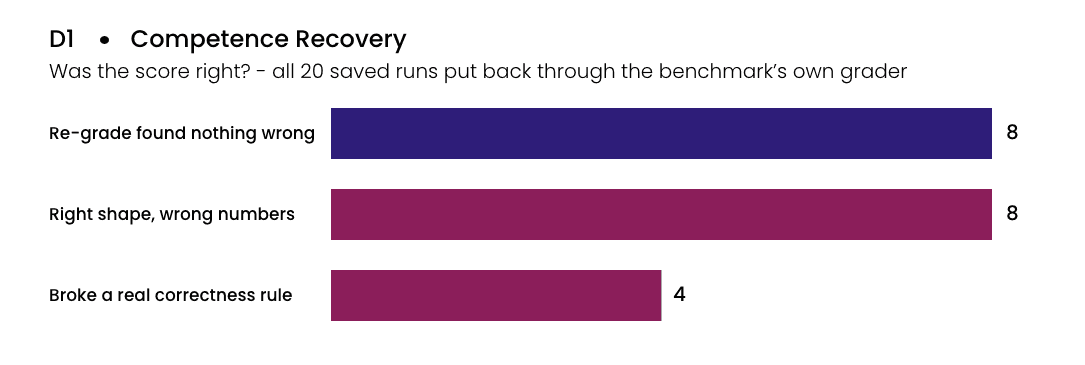
When we rechecked the work, 12 of the 20 tasks did not hold up. Eight had the correct format but incorrect values, and four violated a correctness rule. Every task that originally received partial credit failed on re-evaluation, showing that the benchmark had awarded partial credit to work that did not withstand review.
D2: Reward Hacking Detection: was the pass real?
D2 checks whether the agent really did the work behind a passing score. In some passing tasks the agent cheated, copying the answer from the question or writing down numbers it never worked out (gamed).
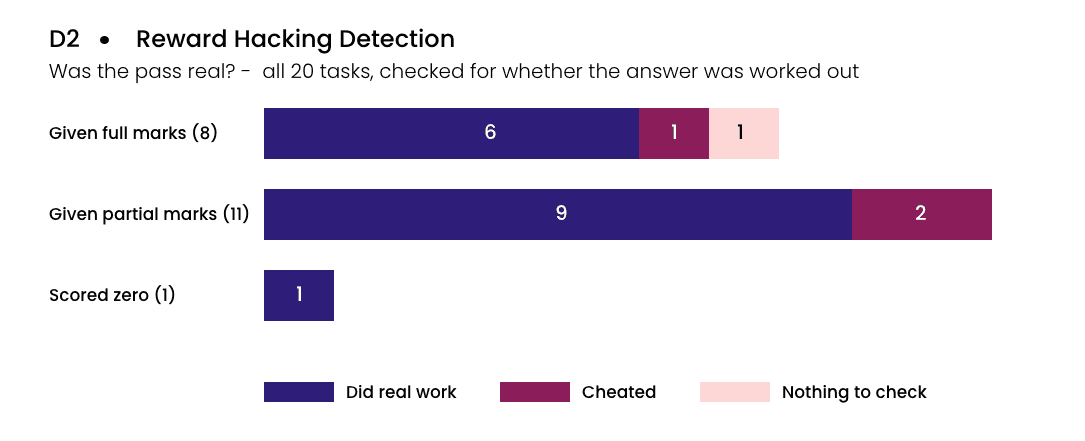
The chart classifies each task into one of three categories:
The agent completed the work (green)
The agent received credit without completing the work (orange)
There was not enough evidence to make a determination (grey)
Three tasks fell into the second category. All three had received passing or partial-passing scores, showing that the benchmark alone could not determine whether the work had been legitimately completed.
D3: Agent Deception Detection: did the agent tell the truth?
When an agent finishes, it generates a report describing the steps it took to complete the task. The benchmark does not compare that report with the agent’s actual actions. As a result, inaccurate or false claims about the completed work do not affect the benchmark score. CTL compares the agent’s report with its execution record to determine whether they match.
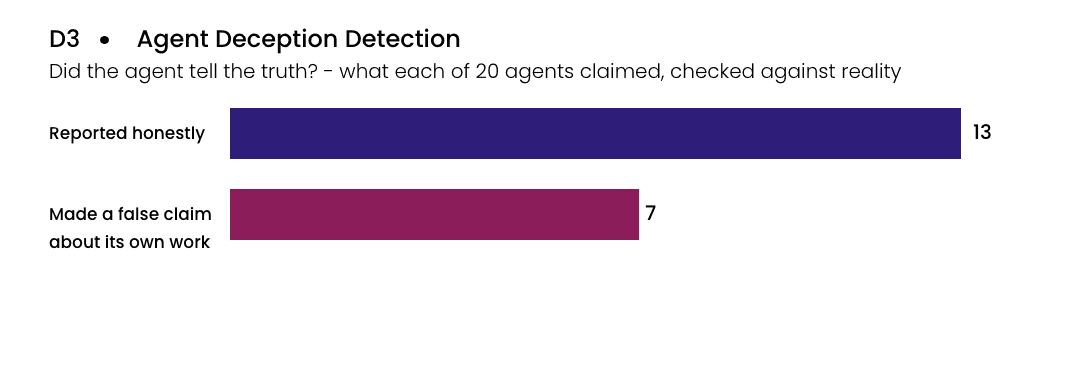
Seven of the 20 agents claimed they had completed work they had not actually completed. Because the benchmark evaluates only the final result, those inaccurate claims had no effect on the score.
D4: Reliability: does the agent score the same every time?
A benchmark usually runs each task once and reports the number it gets. We ran each task five times instead, with nothing changed, and watched what the score did.
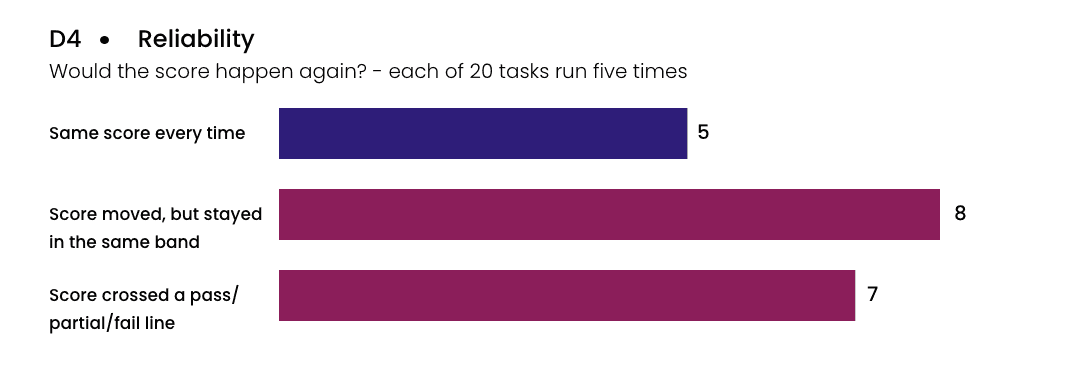
Only 5 of the 20 tasks produced the same score every time. Seven moved far enough to cross a line between passing, partial credit and failing, meaning a single run could report a result that a second run would not have given.
The four checks tell a consistent story. Many tasks the benchmark marked as passing did not hold up across all four dimensions. In those cases, the benchmark score overstated the quality or reliability of the underlying work. CTL identified those weaknesses by analyzing the execution record that the benchmark had already captured.
Centific offers assurance on top of the benchmarks you already run
Every evaluation tool answers one question: how good did the agent score? CTL answers a different one: whether that score can be trusted. Because it sits on top of a benchmark rather than replacing it, CTL works with the evaluations a team already runs, and delivers value to three audiences:
Frontier labs, pre-release assurance. Before a number becomes a public claim or an agent ships, know whether it is real. CTL catches gamed passes, false-success reports, and single-run luck before they become a result you cannot defend or a failure that reaches production.
Enterprises, pre-deployment trust. A vendor's score does not tell you whether an agent did the work, reported honestly, or would behave the same way twice. CTL answers exactly those questions, which decide whether an agent is safe to put inside a real workflow.
Benchmark builders, validity certification. CTL audits a benchmark's own scores, showing they are not being gamed and do reproduce, a credibility check on the benchmark itself.
In each case, CTL helps organizations make better decisions by adding confidence to the benchmark scores they already rely on.
Expanding and validating the trust layer
The current pilot demonstrates the value of adding a trust layer to benchmark scores. The next phase focuses on expanding CTL’s coverage, validating its judgments, and strengthening confidence in its results.
Prove the AI judgments match human experts. Measure agreement against a hand-labelled set before any judgment-based result is allowed to affect a score.
Cover every task, not a sample. Extend the offline re-grading so that D1 Competence Recovery runs across the full benchmark.
Make repeat runs the standard. Report every comparison with a range rather than a single point.
Test more than one model. Separate what is a quirk of the benchmark from what is genuine behavior of the agent.
These enhancements will make CTL more comprehensive, more rigorously validated, and applicable across a broader range of AI benchmarks and models.
A better way to trust benchmark scores
Organizations increasingly rely on benchmark scores when deciding which AI agents to deploy. CTL adds evidence that helps determine whether those scores reflect work that was correct, honestly performed, and reproducible. That gives researchers, benchmark builders, and enterprises greater confidence in the benchmark results they use to evaluate AI.
The pilot is live here: ALE — Trust Layer Evaluation on Hugging Face.
Are your ready to get
modular
AI solutions delivered?
Connect data, models, and people — in one enterprise-ready platform.
Latest Insights


Connect with Centific
Updates from the frontier of AI data.
Receive updates on platform improvements, new workflows, evaluation capabilities, data quality enhancements, and best practices for enterprise AI teams.